“Fairchild semiconductor is like a mature dandelion,” apple’s Steve jobs once said. “when you blow it, the seeds of this entrepreneurial spirit are everywhere.”
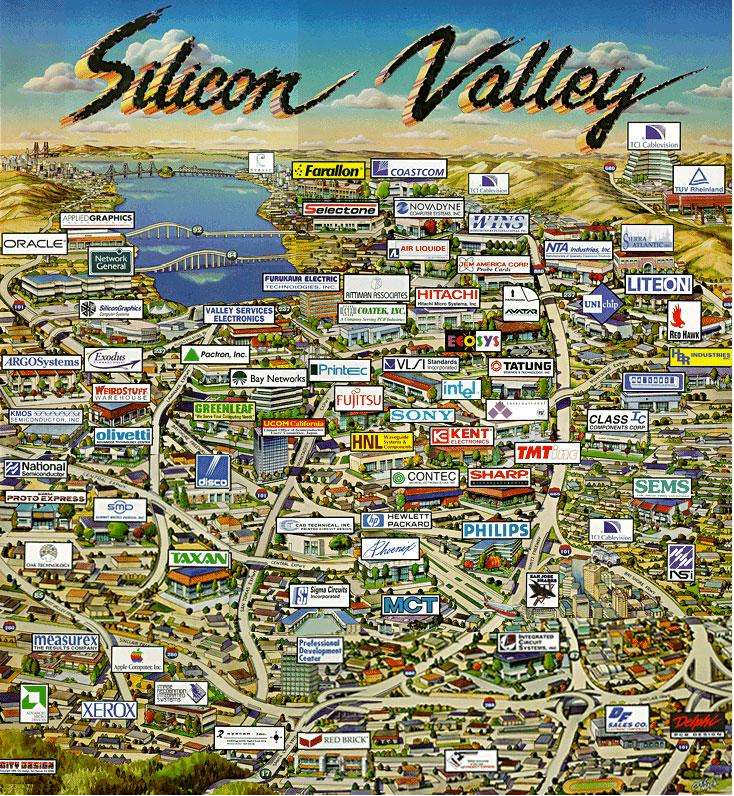
With the brain drain of fairchild, silicon valley gathered too many talents, and all kinds of high-tech companies were born at that time. (speaking of which, we can also explain why there are now three BAT giants in the Internet, and there are so many Internet enterprises around the three giants. In the development process of an industry, some big trees need to grow first, and then it will become a forest.)
At this point, the hardware industry gradually developed mature. Then came the software boom.
In the process of the development of the software industry, we have to mention the names of three companies, IBM, Microsoft and apple
At the beginning of the 20th century, software development was just one of the job functions of a hardware engineer, kind of like the product manager job in the old days where it was a project manager or a marketing manager at the very beginning.
But in the middle of the 20th century, the U.S. SAGE air defense system, developed between 1949 and 1962, was the first major computer project, eventually costing $8 billion. In 1959, Rand established a separate company, the system development corporation (SDC), to further develop the software, which was estimated to require one million lines of code. The rand corporation is one of the most important comprehensive military-oriented strategic research institutions in the United States. The SAGE software development program became one of the most “noble” undertakings in software engineering development. The number of programmers in the United States at that time was about 1,200, with 700 working on the SAGE project.
In addition, in 1954, when American airlines asked IBM to develop the SABRE aircraft reservation system, the first industry-funded software project was launched, a $30 million project employing about 200 software engineers. It was completed in 1964.
Both SAGE and SABRE systems became “programmers’ universities.” Since then many programmers have spread across the country, using what they learned on these big projects to start their own companies.
IBM’s history can be traced back to decades before the development of electronic computers. The company was founded to make typewriters. In 1964, IBM announced the advent of the mainframe with the epoch-making System / 360 mainframe computer. Since then, almost all of the world’s computer development and development of the IBM360 series system as a benchmark, has become an important trend in the world. In this way, the hardware structure and operating system of the computer had the first standard. In 1975, IBM produced four times as many computers as all the other computer manufacturers in the world combined.
Because IBM was too big, the justice department sued, arguing that it was trying to corner the market for general-purpose digital computer systems.
At this time, apple appeared. Jobs persuaded wozniak to start Apple computer in 1976, and the Apple II was launched in 1977. The Apple II became the first personal computer in human history.
Meanwhile, in 1975, Bill Gates dropped out of Harvard University to start Microsoft. Started selling the programming language BASIC.
Then, a lot of things happened to the three companies that will have a profound impact on the future of the software industry.
The first was that IBM, from top to bottom, in the mid-to-late 1970s almost always thought the personal computer was a low-grade thing, not worth the effort. With the apple II on the market and selling more than a thousand units a month, IBM couldn’t sit still and decided to enter the PC market. However, IBM found that it did not have a working personal operating system, so it secretly approached Bill Gates to provide an operating system for IBM’s new personal computers. Moreover, gates was asked to sign a legal document promising to keep secrets about what was said and seen during the meeting, and he did so without hesitation. IBM provided a sample PC design on site! This is IBM’s IBM PC prototype, which is a knock-off of the apple computer. That’s how Microsoft landed a crucial order to design an operating system for the IBM PC.
In 1981, IBM introduced its own personal computer. In addition, IBM adopted the CPU made by INTEL in 1983, which formed the current personal computer industry standard.
Then came the period of market competition between open and closed systems. Jobs was fired from his company in 1985 because of his personality. Since then, the standards and development of personal computers have been determined down.
Well, now that the electronics industry has matured, telegraph and telephone services are available, and personal computers are widely used, operating systems and software are available. So what’s still missing from the Internet?
To connect all these things, we need an agreement. An agreement that they can all read. Here’s how the Internet was born.
The earliest origins of the Internet are the ARPANET of the defense advanced research projects agency, which was put into use in 1969. ARPANET is mainly used for military research purposes, it is mainly based on the guiding ideology: network must withstand the test of failure and maintain normal work, in the event of war (such as suffering from a nuclear strike), when a certain part of the network due to attack and lose the ability to work, the rest of the network should be able to maintain the normal work of communication. ARPANET is a communications network built by the U.S. department of defense to withstand a nuclear attack by the former Soviet union. The early purpose of the Internet, as you can imagine, was a way for people to get in touch after a nuclear attack.
Another important technical contribution of ARPANET is the development and utilization of TCP/IP protocol clusters.
 Vincentmedia